

- VA loan lenders typically require two years of consistent income, but every employment scenario is different.
- If you have less than two years on the job, lenders evaluate your employment history, training, education and income stability on a case-by-case basis.
VA loan approval doesn’t always require a full two years on the job. While lenders typically want to see at least two years of stable employment, there are exceptions. Education, military service and certain career paths can sometimes count toward that history.
Every borrower’s situation is unique, which is why VA lenders verify employment on a case-by-case basis.
Does the VA Require a Two-Year Work History?
The VA requires that you show two years of stable income, although they do not need to be from the same employer or position. Breaks between employment must be substantiated.
Lenders often require a similar two-year history when reviewing VA loan income requirements. Note that VA lenders have overlays and may have different income guidelines than VA’s requirements.
If you have less than two years on the job, a lender may take a careful look at these indicators:
- The nature of your current job and your training, education and qualifications for it
- How long you’ve been in your current job, and whether it’s related to your previous job experience or education
- Your Military Occupational Specialty (MOS) or past employment record, including the length of time at other jobs
- Your employer’s confirmation that your job is likely to continue
Every employment scenario is different, and lenders typically evaluate them on a case-by-case basis.
An underwriter is looking for verifiable, stable income that is likely to continue. It is advised that borrowers avoid job changes during the loan process, as this requires re-verification and may delay closing.
Common Scenarios for Less Than Two Years of Employment
Lenders understand that not every Veteran or service member has a long work history with their current employer. What matters most is showing stability and the likelihood of continued income.
In many cases, a VA loan applicant may have been on the job for less than two years and still meet the employment requirement. Let’s take a look at some typical situations.
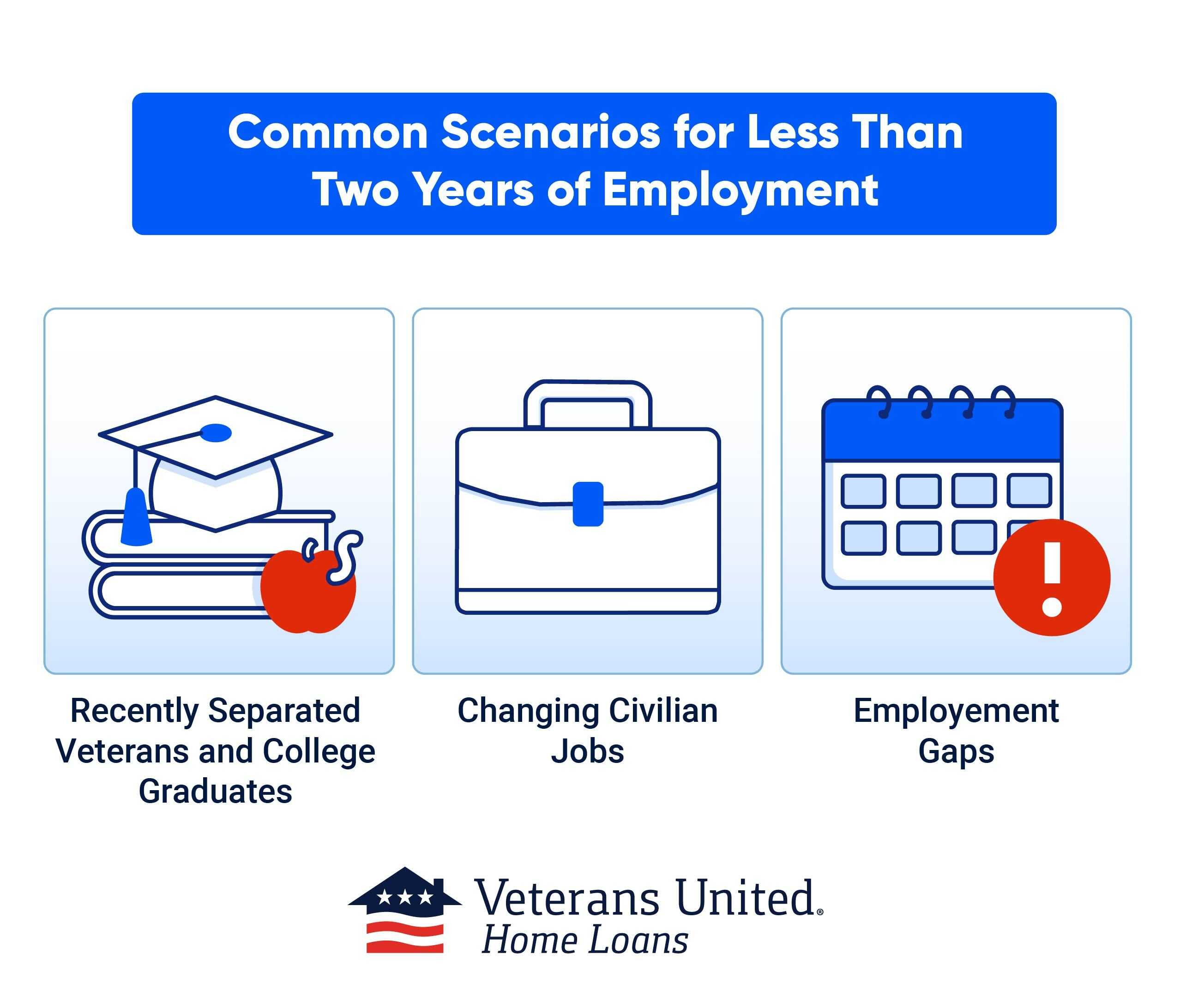
Recently Separated Veterans and College Graduates
Depending on their purchasing timeline, Veterans who recently left the military and recent college graduates may not have been in their current job for two years. However, if there’s a clear connection between your MOS, education or training and your new job, lenders may approve a VA loan even with minimal work history.
If lenders feel there is continuity, then you may be able to move forward immediately with the VA loan process. Even Veterans who are brand new on the job may be able to close on a loan with just a single pay stub from the new gig.
A clear connection between past job/education and future work is one of the big issues here. So is a sense of stability and sufficiently documenting your new income. Otherwise, you may need to wait until you’ve been on the job for at least 12 months. Guidelines can and will vary among lenders.
For active-duty military personnel, lenders will want to know more about your future income and employment if you’re purchasing within 12 months of separating from the military.
Changing Civilian Jobs
Broadly, the same is true for Veterans who change jobs in the civilian world. It's common for people to cycle through multiple employers during their lifetime.
If you’ve changed jobs during the past two years, lenders will take a close look at your employment timeline and how your new job and income compare to your previous work, education and training.
If lenders feel there’s enough continuity between old and new, then you may be able to move forward immediately with a VA loan. Otherwise, you’ll often be able to proceed once you’ve been on the new job for 12 months.
For example, say you're working as a processor at a company earning a salary at $50,000 a year. You are offered another job at a competitor doing the exact same work and job title, but with the ability to earn more.
This new job offers you compensation of $40,000 a year base, but offers overtime pay unlike your current employer and it can be a substantial increase. You estimate that you could earn upwards of $75,000 ($35,000 of this in overtime) per year with this new pay structure, leveraging your current knowledge and abilities to take on this new position.
While this seems like a great opportunity for you to make more money, if the overtime isn't guaranteed and you don't have a history of making it with your previous employer, lenders may have trouble using that income to qualify you with that extra income before 12 months of history with the new employer.
Again, every lender and employment scenario is different, so it is important to remember that each case is reviewed individually.
Gaps in Employment
Whether from layoffs, caregiving or personal reasons, employment gaps don’t automatically prevent you from getting a VA loan. Prospective borrowers who’ve experienced a gap in employment may be able to move forward well before being back in the workforce for two years.
However, policies and employment requirements can vary by lender.
The Bottom Line
While VA loan employment requirements usually call for a documented two-year work history, there’s flexibility. If you’ve been in your current role for less than two years, lenders may still approve your loan if your income is stable and your employment history shows continuity.
Your exact situation will depend on your lender’s requirements and how well your past education, training and employment support your current role. Reach out to a Veterans United VA loan expert at 855-870-8845 to discuss your employment or get started online today.
How We Maintain Content Accuracy
Our mortgage experts continuously track industry trends, regulatory changes, and market conditions to keep our information accurate and relevant. We update our articles whenever new insights or updates become available to help you make informed homebuying and selling decisions.
Current Version
Jan 7, 2026
Written ByChris Birk
Reviewed ByDon Wilson
Updated article for further context and added graphic. Content reviewed and fact checked by underwriter Don Wilson.

Related Posts
-
 VA Renovation Loans for Home ImprovementVA rehab and renovation loans are the VA's answer to an aging housing market in the United States. Here we dive into this unique loan type and the potential downsides accompanying them.
 -
 Pros and Cons of VA LoansAs with any mortgage option, VA loans have pros and cons that you should be aware of before making a final decision. So let's take a closer look.


